Patterns and rules
Questions about finding a rule from a few examples and using it: picture grids, balance scales, pictures that belong together, and math stories told out loud.
This group is closest to what people usually picture as “reasoning”. The skill that carries over is a habit: look at the examples, say the rule, then check every answer against it.
Pattern Finder
In WISC-V terms: Matrix Reasoning. It practises: finding the rule in a visual pattern and using it to fill in the missing piece.
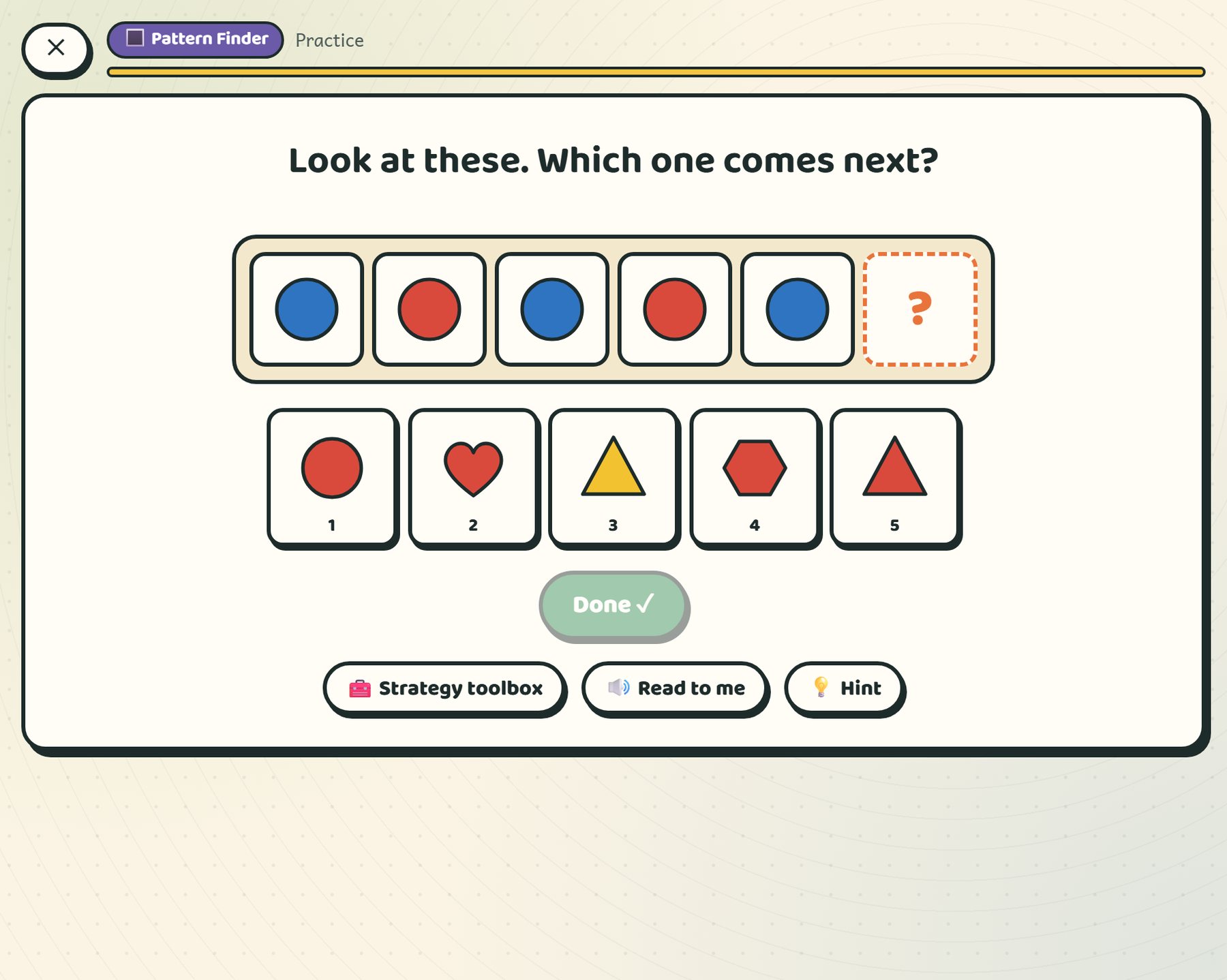
Matrix Reasoning measures fluid reasoning: noticing patterns, forming a rule from a few examples (induction), and applying it to a new case. It is a core subtest of the Fluid Reasoning Index and the Full Scale IQ, and it is nonverbal, so it is less tied to vocabulary. Items here are generated fresh, so practice builds the strategy (look, name the rule, check every row) rather than memorising answers. Wrong answers are designed to be “near misses” that are right in all but one way, so encourage your child to check every rule rather than picking the answer that “looks most like the others”.
How it plays
- Look at the boxes. One box has a “?”.
- Figure out the rule that the boxes follow.
- Tap the piece that fits the rule, it will pop into the gap so you can check it.
- Tap Done when you are sure.
Strategies to show your child
- Look across the rows. Read each full row like a sentence. What happens from the first box to the last? The last row should do the same thing.
- Look down the columns. Sometimes the rule is easier to see going down. Compare the top box of a column with the ones under it.
- Name what changes. Say it out loud: “it gets bigger”, “one more dot”, “it turns”. Check color, shape, size, how many and which way it points, big puzzles change two or three things at once.
- Predict before peeking. Picture the missing piece in your mind BEFORE you look at the answers. Then hunt for the one that matches your picture.
- Cross out the impossible. Wrong answers are right in every way but one. Check each answer against the rule and rule out any that break it, the one left standing wins.
Common slips
- Choosing an answer that copies a neighbouring box instead of following the rule.
- Finding one rule (like color) and forgetting a second rule (like size).
- Only looking at the last row instead of learning the rule from the full rows first.
- Rushing to the answers before imagining what the missing piece should look like.
Try at home
- Make bead or LEGO patterns (red-red-blue, red-red-blue…) and take turns asking “what comes next?”
- Play “What’s my rule?”: sort toys into groups and let your child guess the rule (by color, size, or type).
- Spot patterns on walks: fences, tiles, leaves, brick walls, clothing stripes.
- Draw a 3×3 tic-tac-toe grid and fill it with doodles that follow a rule, leaving one box empty to guess.
Balance Scales
In WISC-V terms: Figure Weights. It practises: quantitative reasoning, figuring out what keeps a scale balanced (early algebra).
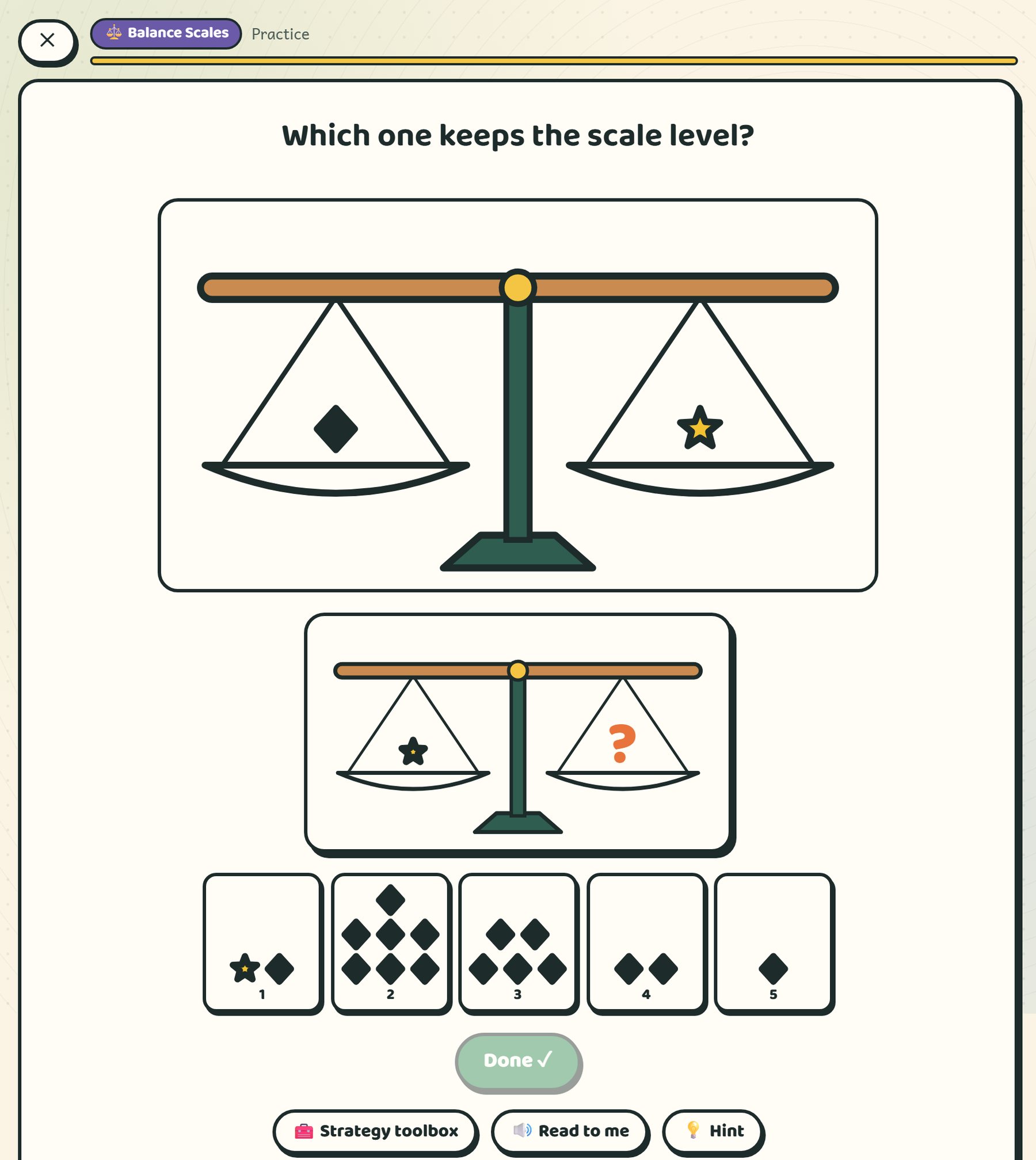
Figure Weights measures quantitative fluid reasoning, the logic behind early algebra: equality, substitution, and keeping both sides balanced. It is a core subtest of the Fluid Reasoning Index and Full Scale IQ, and also part of the Quantitative Reasoning Index. Items are timed (20 s, then 30 s for harder ones), so fluency with simple swaps matters. Every item here is checked by computer: the answer can be worked out from the shown scales (it is not a lucky guess), and every wrong answer is definitely too heavy or too light.
How it plays
- Look at the level scales. Both sides weigh exactly the same.
- Look at the last scale. One side has a “?”.
- Tap the answer that would keep it level, then tap Done.
Strategies to show your child
- Smallest-shape money. Pretend the smallest shape is worth 1 coin. Work out what every other shape is worth in coins, then add up each side.
- Swap it out. If a scale says 1 square = 2 circles, you can always swap a square for 2 circles (or 2 circles for a square). Keep swapping until the shapes match an answer.
- Start from the question. Look at the shapes on the last scale first, then find a clue scale that uses those same shapes. Ignore the others until you need them.
- Take the same off both sides. If both sides of a clue scale have a circle, take one off each side, it stays balanced and gets simpler.
- Double the scale. If 1 triangle = 3 stars, then 2 triangles = 6 stars. You can double (or triple) a whole scale and it stays level.
Common slips
- Counting shapes instead of their weights (3 small shapes are not always heavier than 1 big one).
- Stopping one step early in a chain (finding squares when the answers use circles).
- Forgetting that a shape already on the scale still counts when you swap the others.
- Using a clue scale backwards or mixing up which shapes it links.
Try at home
- Play with a real balance or a coat-hanger scale: how many pennies balance a toy car?
- Trading games: “1 big cookie = 2 small cookies; how many small cookies for 3 big ones?”
- Make change with coins: 1 dime = 2 nickels, 1 nickel = 5 pennies, so 1 dime = ? pennies.
- Seesaw talk at the playground: who needs to sit where to make it level?
Picture Pals
In WISC-V terms: Picture Concepts. It practises: spotting the hidden category that links pictures across rows.
Picture Concepts measures categorical and inductive reasoning without words: spotting the abstract concept that links pictures across rows. It is a supplemental Fluid Reasoning subtest. Children who name concepts aloud (“they’re both for your feet”) tend to do better, so encourage talking it through. Note it has the lowest retest stability of the WISC-V subtests, so single scores bounce around.
How it plays
- Look at every picture in every row.
- Tap one picture in each row. Tap it again to change your mind.
- Your pictures must share one idea, like “they are all fruits”.
- Tap Done when every row has a pick.
Strategies to show your child
- Name the group. Say a group name for each picture: “animal”, “food”, “something you wear”. Then look for a match in the next row.
- Ask what it does. If groups don’t match, ask what each thing is FOR: cutting, riding, keeping warm, making light?
- Ask what it has. Look at parts and features: wheels, wings, a shell, stripes, fur. Two very different things can share one!
- Start with the shortest row. Pick the row where only one or two pictures could link to anything, and test those first.
- Check every row. A link that works for two rows but not the third is a trap. Your idea must work for every row.
Common slips
- Linking by colour or looks instead of by what things are or do.
- Finding a link between two rows and forgetting to check the third.
- Choosing two things that go together (a key and a lock) rather than two things that are the same kind.
- Stopping at the first idea instead of trying another kind of group.
Try at home
- “Odd one out” and “What do these have in common?” games in the car.
- Sort toys, groceries or laundry in different ways: by colour, then by use, then by where they belong.
- Category games like Scattergories Junior or “I’m going on a picnic” with a hidden rule.
- Look through picture books and ask: which two things here go together, and why?
Math Stories
In WISC-V terms: Arithmetic. It practises: solving spoken math stories in your head, number sense plus working memory.
Arithmetic measures quantitative reasoning together with working memory: the story is heard, held in mind and solved without paper. It is a secondary Fluid Reasoning subtest and part of the Quantitative Reasoning and (with Digit Span) can be informative about attention and auditory working memory. Items here move from counting pictures to adding and taking away within 20, then times tables, money, time, fractions, percents and rates. As on the real test, in test mode the story can be repeated only on the later (harder) items; practice and tutor modes always allow one repeat. On the early counting items your child can tap each picture to number it, like pointing while counting. The best practice is lots of everyday mental math talk: estimate, explain how you got it, and use pictures or “bars” in your head.
How it plays
- Tap “Read me the story” and listen carefully.
- Work out the answer in your head.
- Counting pictures? Tap each one as you count, it gets a little number.
- Tap the numbers on the keypad, then Done. On the harder stories you can hear the story one more time if you need to.
Strategies to show your child
- Make a movie. Picture the story like a little movie: see the ducks land, the cookies get eaten. Then you know if things are joining or leaving.
- Find the question word. Listen for the end: “how many in all?” (put together), “how many left?” (take away), “how many more?” (find the difference), “each” (share or times).
- Estimate first. Before working it out, guess: should the answer be bigger or smaller than the numbers in the story? About how big? Then check your answer makes sense.
- Draw a bar in your mind. Imagine a bar for each amount. Joining? Stick bars together. Comparing? Put one bar under the other and look at the extra bit.
- Use friendly numbers. Make a ten (8 + 5 = 8 + 2 + 3 = 13), split hard numbers (7 × 6 = 5 × 6 + 2 × 6), or count up to make change.
Common slips
- Grabbing the numbers and adding them without listening to what the question asks.
- Stopping after the first step of a two-step story.
- Losing a number while working, whisper it to yourself to keep it.
- For “how many more”, adding instead of finding the difference.
Try at home
- Make up story problems in the car or at dinner: “We have 6 forks and 4 people come. Do we have enough?”
- Let your child pay at a shop and work out the change before the cashier does.
- Cook together: double a recipe, or work out half of 12 cookies.
- Count by 2s, 5s and 10s while walking up stairs or swinging.
Every puzzle in IQ Prep is original and generated on the spot; none are real test questions, and practice results are estimates, not IQ scores. The aim is familiarity, so a test measures your child’s thinking rather than their surprise. For questions about a particular assessment, ask the psychologist who gives it.