Shapes and space
Questions about seeing how shapes fit: copying a design with blocks, and choosing the pieces that make a shape without moving them.
These are visual and mostly wordless. Speed matters a little, because the real versions are timed, but accuracy and a calm method matter more.
Block Builder
In WISC-V terms: Block Design. It practises: analyzing a pattern into parts and rebuilding it, spatial reasoning with hands and eyes.
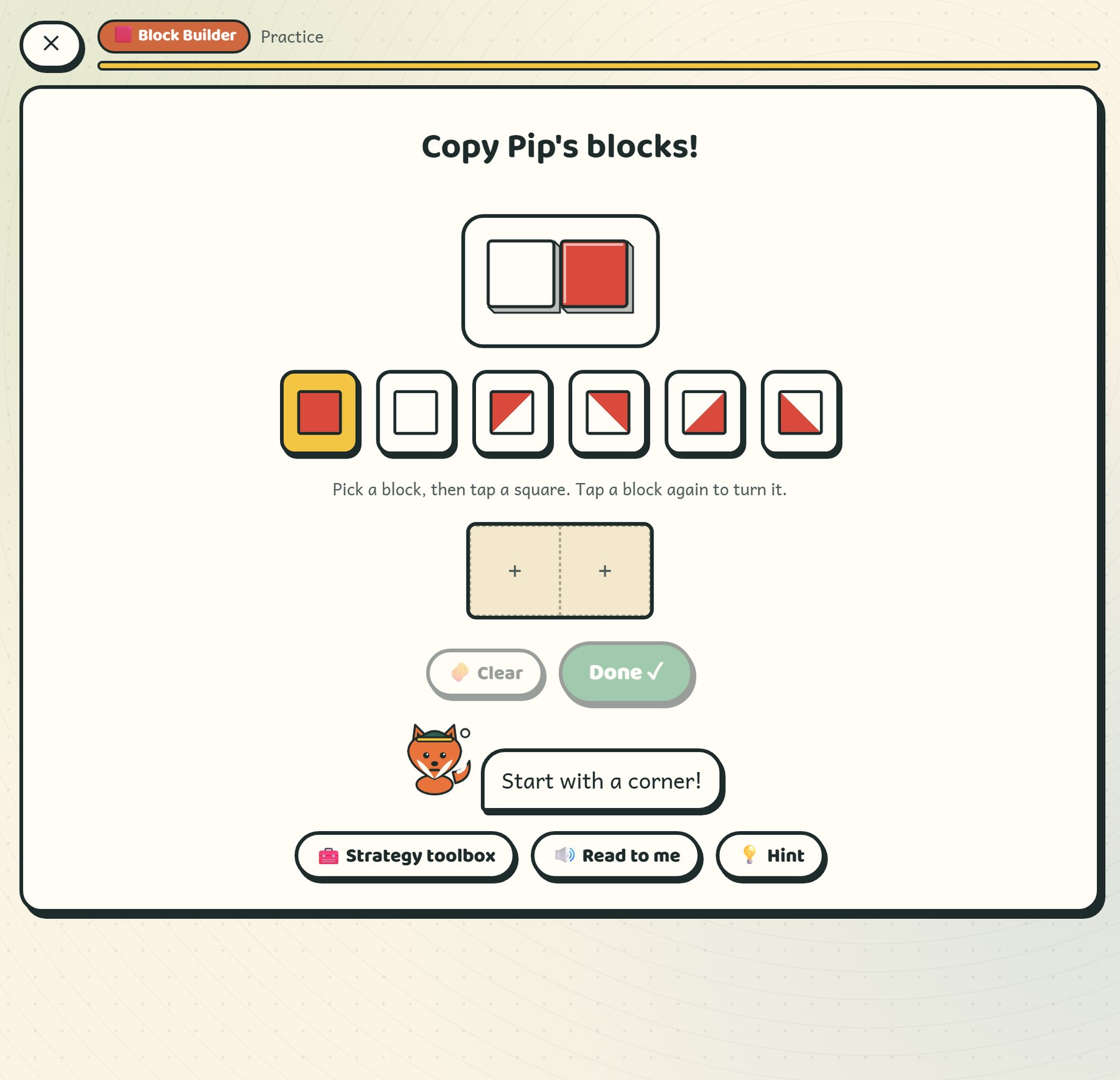
Block Design measures visual-spatial analysis and synthesis: breaking a whole design into parts and rebuilding it, plus visual-motor construction under time pressure. It is one of the seven FSIQ subtests and half of the Visual Spatial Index. Here the blocks are on-screen; the strategies (corner-first, mentally gridding the design) transfer directly to real cubes. As on the real test, the first (model) items allow a second try after Pip rebuilds the model (2 points first try, 1 point second), and from about age 8 the build goes on an open board with no outline, so the child must judge the design’s size, spreading it too wide is recorded as a dimension error. Cheap 1-inch red/white cube sets are a great off-screen companion.
How it plays
- Look at the picture at the top.
- Pick a block: all red, all white, or half-and-half.
- Tap a square to put the block there. Tap it again to turn it.
- On a big board you can build anywhere, just make it the same size as the picture.
- Tap Done when your design matches the picture.
Strategies to show your child
- Corners first. Build the four corner blocks first, they are the easiest to see. Then fill in the middle.
- Count the red triangles. Count the half-red triangles in the picture. That tells you how many half-and-half blocks you need before you start.
- Row by row. Go like reading: build the top row left to right, then the next row. Finish one row before starting another.
- Outside edge first. Look along the outside edge of the picture. Match the edge blocks first, then the inside ones are easy.
- Find the big shape. See a big diamond, stripe or arrow? Work out which blocks make that shape, build it, then fill the white around it.
Common slips
- Building a design that is correct but turned around (a rotation error).
- Making the design too big, e.g. three blocks in a row for a 2-by-2 design (a dimension error).
- Turning a half-red block so the red corner points the wrong way.
- Seeing a big diamond as one shape instead of four half-red blocks.
Try at home
- Copy simple LEGO or Duplo patterns from a picture or from a model you build.
- Tangrams and pattern-block puzzles (copy the outline).
- Make red/white designs with paper squares cut on the diagonal, then copy each other’s designs.
- Quilt-block and tile patterns: spot the repeating squares and triangles.
Puzzle Pieces
In WISC-V terms: Visual Puzzles. It practises: mentally putting pieces together to make a shape, without touching them.
Visual Puzzles measures mental assembly: holding pieces in mind, rotating them mentally and checking whether they fit, without touching them. It is one of the Visual Spatial Index subtests (with Block Design). The real task has a strict 30-second limit, so quick strategies such as counting squares and ruling out impossible pieces really help.
How it plays
- Look at the big shape at the top.
- Tap the 3 pieces that fit together to make it. Tap again to un-pick.
- Pieces can turn around, but they never flip over.
- Tap Done when you have 3. (In a Challenge, picking your third piece hands it in.)
Strategies to show your child
- Count the squares. Count the squares in the big shape and in each piece. Your three pieces must add up to exactly the same number.
- Tricky part first. Find the strangest bump, corner or slanted edge of the big shape. Which piece could fill just that spot?
- Biggest piece first. Start with the biggest piece. Once you know where it goes, the leftover gap tells you what the other two must look like.
- Turn it in your head. Imagine picking a piece up and turning it like a steering wheel until its edges match the big shape.
- Cross out the cheats. Rule pieces out: one square too big, one too small, or flipped like in a mirror. Fewer pieces left means an easier choice.
Common slips
- Picking pieces that look right but would need to be flipped over (mirror images).
- Choosing a piece that is one square too big or too small, counting would catch it.
- Picking two good pieces and guessing the third without checking for gaps.
- Staring at one piece too long instead of trying the next one.
Try at home
- Tangrams: make a shape from the outline only.
- Jigsaw puzzles, say which piece will fit before trying it.
- Pattern blocks or pentomino sets: cover an outline using exactly three pieces.
- Cut a paper square into 3 pieces, mix them, and race to rebuild it, then try it only by looking.
Every puzzle in IQ Prep is original and generated on the spot; none are real test questions, and practice results are estimates, not IQ scores. The aim is familiarity, so a test measures your child’s thinking rather than their surprise. For questions about a particular assessment, ask the psychologist who gives it.